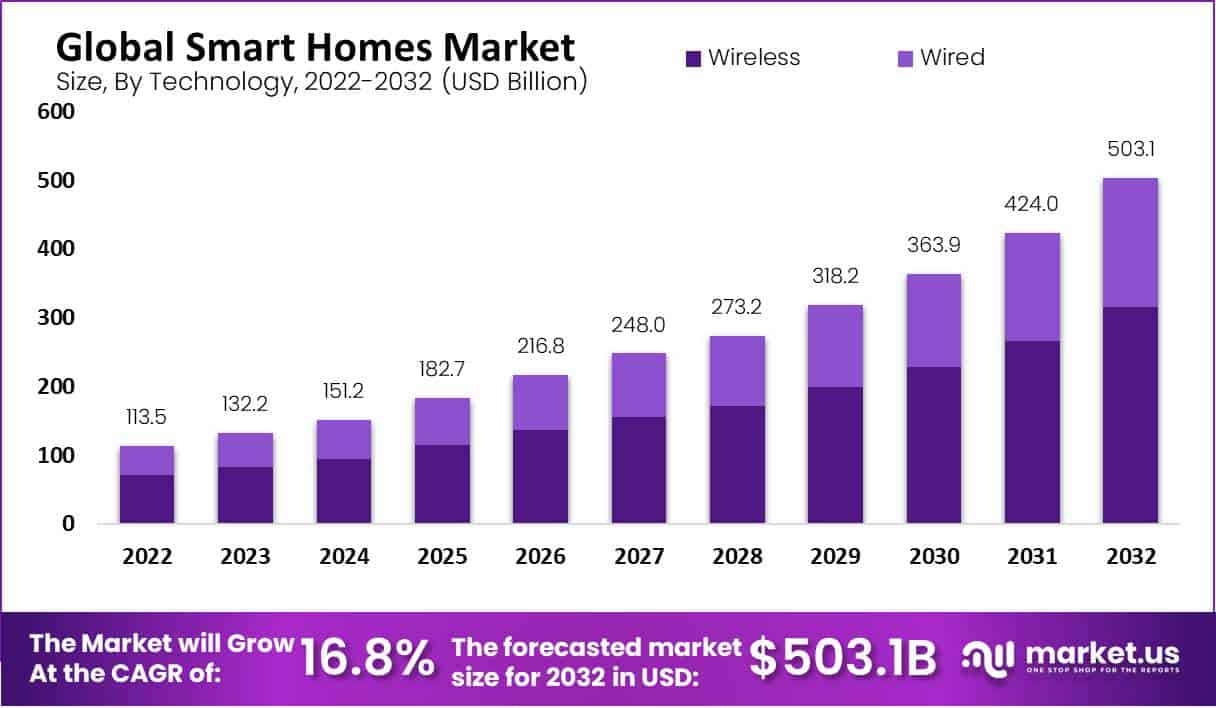
In 2022, the Global Smart Homes Market was valued at USD 113.5 Billion and it is expected to reach USD 503.1 billion between 2023 and 2032, this market is estimated to register the highest CAGR of 16.8%.
The smart homes market refers to the adoption of connected devices and technologies in residential properties to enhance convenience, comfort, and security for homeowners. This market has witnessed significant growth in recent years due to advancements in Internet of Things (IoT) technology, increased consumer awareness, and rising disposable incomes.
For comprehensive details on the market size of historic period (2017 to 2021) and forecast period (2023-2027) – View a sample report
Editor’s Pick
- 78% of homebuyers planning to make smart homes an integral component of their purchase decision are willing to spend extra for such features, on average in America there are 8 smart devices per home on average and two out of three Americans worry that personal data might leak due to this technology.
- On average, revenue generated from each installed Smart home is projected at an estimated average revenue gain of $381.90 and is projected to experience a compound annual growth rate of 10.63% between 2022-2027 to reach $64.244 billion by 2027.
- 57% of those aged 55 or above do not see any need to install smart gadgets into their homes, according to research conducted in 2018.
- Asia Pacific is projected to become the primary market for Smart Homes by 2023.
- As per Smart Home Statistics, 2023’s expected revenues total $139.30 billion with 18.5% annual change.
- By 2025, global smart device shipments will consist mainly of smart lighting systems (26%), security cameras (23%), speakers (19%), smart television (14%), and other forms of intelligent devices (18%).
- United States of America projections anticipate an anticipated total number of smart homes reaching 140 million by 2027.
Source – https://www.enterpriseappstoday.com/stats/smart-home-statistics.html
Market Demand and Trend:
The demand for smart homes is expected to continue growing as consumers seek more convenience, energy efficiency, and security in their homes. The integration of smart home devices with voice assistants and mobile applications has become a prominent trend, enabling intuitive control and personalized experiences. The market is also witnessing a trend toward interoperability and standardization, with efforts to create unified platforms and protocols for seamless integration among different smart home devices. Additionally, there is a growing demand for energy management solutions and connected health monitoring devices within smart homes.
Top 5 Must-have Smart home Gadgets in 2023
- Amazon Echo (4th Gen) (smart speaker category)
- Google Nest WIFI Router (Smart network extender)
- Robot Vacuum (Self-cleaning robot category)
- Smart Security Camera (Smart security devices category)
- Home WIFI Smart Lock (Smart security devices category)
Smart Home Statistics By 10-Year Analysis [Image Source- https://www.enterpriseappstoday.com/]

Regional Landscape:
The smart homes market is experiencing growth across various regions, with North America, Europe, and Asia Pacific leading the way. North America has been an early adopter of smart home technologies, driven by technological advancements, high disposable incomes, and a strong emphasis on convenience and security. Europe is also witnessing significant growth, fueled by government initiatives promoting energy efficiency and sustainable living. The Asia Pacific region is expected to grow rapidly, driven by increasing urbanization, rising middle-class population, and expanding Internet connectivity.
Market Overview: The smart homes market refers to the adoption of connected devices and technologies in residential properties to enhance convenience, comfort, and security for homeowners. This market has witnessed significant growth in recent years due to advancements in Internet of Things (IoT) technology, increased consumer awareness, and rising disposable incomes.
The report provides a full list of key vendors, their strategies, and the latest developments. Buy now
Smart Home Statistics By Region
Worldwide
- By 2022, it is expected that revenues from the Smart Home market will reach $117.60 billion worldwide.
- Furthermore, when we look at the world comparison by 2022, a majority of the revenues come from the markets in the United States of America resulting in the sum of $31,450 million.
- According to 2023’s data, according to Smart Home Statistics, the estimated revenue would be $139.30 billion, with 18.5 percent change in the revenue.
- In 2027, it’s been estimated that the total amount of households active within the Smart Home Segment will be 672.60 million.
- Additionally, the anticipated household penetration in 2022 was 14.2 percent. This will increase to 28.8 percent in 2027.
- In the average, revenues through each Smart home will be $381.90.
Asia
- Within the Asian Smart home market, the expected revenue in 2023 will be $55.19 billion. This is accompanied by the revenue expected to increase by 19.7 percent.
- The total number of households predicted to grow by 349.20 million.
- Additionally, the revenues in the Smart Home segment was projected to be $46.12 billion. This is accompanied by an annual increase of CAGR 14.26 percent from 2022 until 2027, which will reach $94.07 billion in market value by 2027.
- The household penetration expected by 2022 is 12.6 per cent, which is predicted to increase to 27.1 percent by 2027.
- In addition, in 2023, projected revenues from the Asian Smart home segment is $55.19 billion, with an increase of 19.7 percent.
Americas
- Smart Home Statistics indicate that, by 2027 the revenue average for each Smart house located in America will be $483.10. United States of America will be $483.10.
- In addition, American Smart Home market revenue will increase by an annual rate of 10.63 percent between 2022 and 2027 and will reach $64.24 billion in 2027.
- In addition, household penetration is predicted to increase to 39% in 2027.
- Within the United States of America, the number of smart homes is predicted to grow by 140 million in 2027.
- In 2023, the anticipated revenue will be $42.89 billion and a rise in revenues of 13.3 percent.
Africa
- The anticipated revenue for the Smart Home market in Africa will reach $1,812 billion with the revenue increasing by 16.6 percentage compared with the last year.
- The median revenue per smart home on Africa is projected at $156.90. African market is forecast to be $156.90.
- Furthermore it is estimated that there is a possibility that the African Smart home market is predicted to expand at a rate of 11.30 percent from 2022 until 2027, reaching a estimated market worth of $2,781 million by 2027.
- The current amount of smart homes in use to 2027 is expected to be 22.61 million.
- In addition, by 2022, revenue from the Smart Home market was projected to be $1,554 million.
Europe
- The projected revenue of the European region in 2023 will be $35.51 billion, with an increase of 24.2 percent.
- Furthermore, the amount of smart homes that are active in 2027 will be 150.50 million across Europe.
- It is estimated that the European Smart home market revenue will increase by an annual rate of 12.15 percent from 2022 until 2027. It will reach $56.18 billion in 2027.
- In the same way, in 2027, the percentage of households with a home is expected to be 40.9 percent.
- The mean revenue of every fitted smart house is $449.80.
Key Takeaways:
- Growing demand for home automation: The increasing desire for convenience and energy efficiency has driven the adoption of smart home automation systems. These systems allow users to control various aspects of their homes, including lighting, security, entertainment, and temperature, through integrated smart devices and mobile applications.
- Advancements in IoT and AI: The integration of Internet of Things (IoT) and artificial intelligence (AI) technologies has enabled seamless connectivity and intelligent automation within smart homes. IoT devices, such as smart thermostats, smart speakers, and smart security systems, can communicate and adapt to user preferences, creating personalized and intuitive experiences.
- Rising focus on energy efficiency: Smart homes offer the potential for significant energy savings through optimized energy management. Homeowners can monitor and control their energy consumption through smart meters, smart lighting systems, and smart appliances, resulting in reduced energy bills and a more sustainable lifestyle.
- Enhanced security and safety features: Smart home security systems have become increasingly sophisticated, incorporating features such as video surveillance, motion detection, and remote monitoring. These systems provide homeowners with peace of mind and the ability to monitor their properties in real-time, even when they are away.
- Integration with voice assistants: Voice-controlled smart devices, such as Amazon Echo with Alexa and Google Home with Google Assistant, have gained popularity in smart homes. Users can control various connected devices through voice commands, making interactions more intuitive and seamless.
Market Dynamics
Drivers:
- Increasing consumer awareness and demand for convenience and comfort.
- Technological advancements in IoT, AI, and connectivity.
- Growing emphasis on energy efficiency and sustainable living.
- Rising concerns about home security and safety.
- Integration of voice assistants for seamless control and interaction.
Restraints:
- High upfront costs and installation complexities.
- Privacy and data security concerns.
- Lack of interoperability among different smart home devices and platforms.
- Limited awareness and understanding among certain consumer segments.
- Resistance to change and preference for traditional systems.
Opportunities:
- Expansion of product offerings: Smart home manufacturers have the opportunity to develop new and innovative products to cater to evolving consumer needs. This includes smart appliances, connected home entertainment systems, and health monitoring devices.
- Integration with smart cities: The integration of smart homes with broader smart city initiatives presents opportunities for enhanced urban living. This can include sharing data between homes and municipal services, such as optimizing energy consumption and improving traffic management.
- Aging population and healthcare: With an aging population, there is an increasing need for smart home solutions that support independent living and remote healthcare monitoring. This includes wearable devices, fall detection systems, and medication reminders.
- Energy management services: Companies can offer energy management services for smart homes, providing insights and recommendations to optimize energy consumption and reduce costs. This can be achieved through data analytics and machine learning algorithms.
- Partnerships and collaborations: Collaborations between smart home technology providers, appliance manufacturers, and utility companies can create synergies and unlock new opportunities for seamless integration and enhanced functionality.
Challenges:
- Interoperability and compatibility issues among different smart home devices and platforms.
- Privacy and data security concerns, particularly with the increasing amount of personal data collected by smart home systems.
- Resistance to change and lack of awareness among certain consumer segments.
- Complexity of installation and setup for some smart home devices.
- Need for reliable and high-speed internet connectivity for seamless operation.
Top Key Players in Smart Homes Market:
- Samsung Electronics Co.Ltd.
- LG Electronics Inc.
- Sony Corporation
- Amazon.com Inc.
- Philips Lighting B.V.
- Robert Bosch GmbH
- Siemens AG
- Schneider Electric SE
- Honeywell International Inc.
- ABB Ltd
- Google Nest
- Other Key Players
Key Market Segments:
By Technology
- Wireless
- Wired
By Products
- Security and Access Control
- Smart Locks
- Security Cameras
- Video Door Phones
- Remote Monitoring Software & Services
- Others
- Lighting Control
- Relays & Switches
- Smart Lights
- Dimmers
- Occupancy Sensors
- Others
- Entertainment Devices
- Streaming Devices
- Sound bars and Speakers
- Smart Displays/TV
- HVAC
- Smart Vents
- Smart Thermostats
- Sensors
- Others
- Home Appliances
- Smart Water Heaters
- Smart Vacuum Cleaners
- Smart Washing Machines
- Smart Kitchen Appliances
- Cooktops
- Dish Washers
- Microwave/ovens
- Refrigerators
- Other Products
Explore More Studies Published by Market.us Research:
High Voltage Battery Market Upcoming Trends and Top Company Analysis Report by 2033
Hybrid Fiber-Coaxial (HFC) Market Future Scope Competitive Analysis and Revenue till 2033
Virtual Nutrition Coach App Market Current Trends And Restraints Forecast To 2033
Internet of Medical Things (IoMT) Market Key Players and Competitive Landscape Forecasts by 2033
Epilepsy Surgery Market Trends And Competitive Activity By 2033
Corrugated Bulk Bins Market Demand and Value Forecast 2023-2033
Drone Package Delivery Market Statistics, Facts and Figures 2023-2033
TMJ Disorders Market Futuristic Trends and Growth Potential 2023-2033
Education Catering Market by Trends, Demand and Opportunities to 2033
Hybrid Education System Market is Projected to Show Impressive Growth Between 2023 and 2033
Citrus Water Market Demand, Trend Outlook and Growth Rate Analysis 2023-2033
Cow Colostrum Market Competition, Opportunities and Growth Forecasts by 2033
Plant-Based Tuna Market Latest Research Reveals Key Trends for Business Growth 2023-2033