In vitro fertilization (IVF) is a medical procedure that helps couples struggling with infertility to conceive a child. Advances in technology and science have made IVF one of the most successful assisted reproductive technologies in the world. As a result, the IVF market is expected to grow significantly in the coming years. Here’s an overview of the IVF market and what it means for couples seeking fertility treatments.
IVF Market Growth
The in vitro fertilization (IVF) market refers to the global market for assisted reproductive technology that involves fertilizing an egg with sperm outside the body, in a laboratory setting. IVF is a widely used fertility treatment option for individuals and couples experiencing infertility due to various factors.
In 2022, the Global in vitro fertilization market was valued at US$ 19.5 billion. Between 2023 and 2032, this market is estimated to register a CAGR of 7.8%.
Discover some insights on market size historic period (2017 to 2021) and Forecast (2023 to 2027) before buying the full report –Request a sample report
Key Takeaway: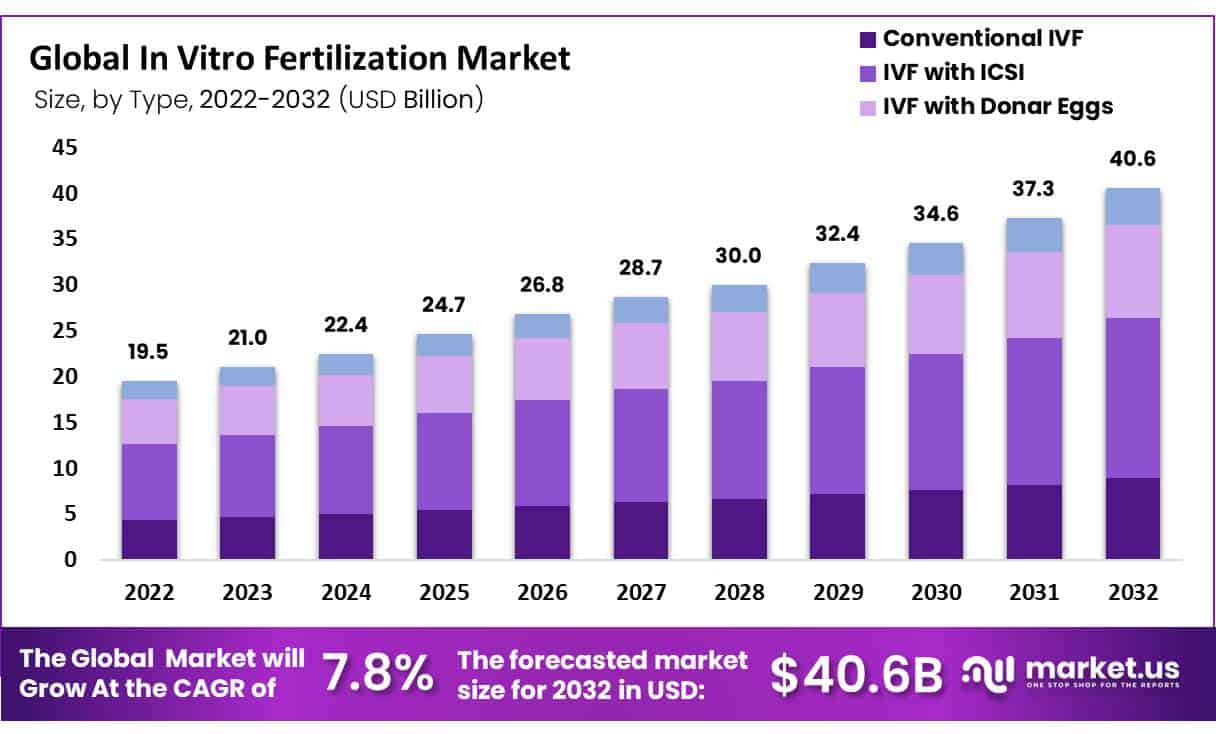
- By Type, the IVF with ICSI segment generated the largest revenue share in 2022.
- By Product, the equipment segment has dominated the market, and it is growing at the highest CAGR over the forecast period 2023 to 2032.
- By Cycle Type, Fresh IVF cycles (Non-Donor) have most of the share.
- By End-User, the fertility clinics segment held the largest share of the market.
- In 2022, North America dominated the market with the highest revenue share of 43%.
- Asia-Pacific will grow at a significant revenue share of 21.6% from 2023-2032.
Factors Driving the IVF Market Growth
Infertility Prevalence
Infertility affects millions of couples worldwide. According to the World Health Organization, infertility affects 10-15% of couples globally. The increasing prevalence of infertility is a critical factor driving the IVF market growth.
Growth in the Number of IVF Procedures
There has been a steady increase in the number of IVF procedures conducted globally. In 2018, over 2 million IVF procedures were performed worldwide, representing a 6.5% increase from the previous year. The rising demand for IVF procedures from couples struggling with infertility is a key factor driving the market growth.
Advancements in Technology
The IVF market has benefited significantly from advancements in technology, including the use of pre-implantation genetic testing (PGT) and artificial intelligence (AI) in embryo selection. These advancements have increased the success rates of IVF procedures and improved patient outcomes.
Directly Purchase a copy of the report | Quick Delivery Available – https://market.us/purchase-report/?report_id=67275
North America currently represents the largest market for IVF, driven by factors such as higher infertility rates, well-established healthcare infrastructure, and higher disposable incomes. However, the Asia-Pacific region is expected to witness the fastest growth due to the increasing awareness about IVF treatments, improved healthcare facilities, and rising infertility rates in countries like China and India.
Comparative Analysis of Adjacent Markets:
The IVF market is closely related to the broader fertility services market, which includes various fertility treatments, diagnostic tests, and fertility drugs. Additionally, the market has overlaps with the genetic testing market, as genetic screening and testing are commonly performed during the IVF process to assess the health and quality of embryos.
Key Benefits for Stakeholders:
- IVF clinics and fertility centers can gain insights into market dynamics and tailor their services to meet patient needs.
- Pharmaceutical companies and medical device manufacturers can identify market opportunities and develop innovative products for IVF procedures.
- Healthcare professionals and fertility specialists can stay updated with the latest trends and advancements in IVF treatments.
- Investors and financial institutions can make informed decisions regarding investments in the IVF market.
- Government agencies and policymakers can formulate effective healthcare policies to support infertility treatments.
Market Segments
Based on Type
- Conventional IVF
- IVF with ICSI
- IVF with Donar Eggs
- Other Types
Based on Product
- Equipment
- Sperm Analyzer Systems
- Imaging Systems
- Ovum Aspiration Pumps
- Micromanipulator Systems
- Other Equipment
- Reagents & Media
- Cryopreservation Media
- Embryo Culture Media
- Ovum Processing Media
- Sperm Processing Media
- Other Reagents & Media
Based on Cycle Type
- Fresh IVF Cycles (Non-Donor)
- Thawed IVF Cycles (Non-Donor)
- Donor Egg IVF Cycles
Based on End-User
- Fertility Clinics
- Surgical Centers
- Hospitals
- Research Institutes
- Other End-Users
Conclusion
The IVF market is expected to grow significantly in the coming years due to the increasing prevalence of infertility, growth in the number of IVF procedures, and advancements in technology. Couples struggling with infertility now have more options than ever before to conceive a child. As the IVF market continues to grow, it is important to consider the potential impact on healthcare costs and access to fertility treatments.
Take a Look at our Related Reports:
- Dental Prosthetics Market Supply and Demand 2023
- Neuroendoscopy Devices Market Trend Analysis Report by 2033
- Ocular Implants Market Global Report [PDF – 2023]
- Foley Catheter Market Growth Rate By 2033
- Cancer Cachexia Market Trends and Forecast by 2023-2033
- Blood Glucose Meters Market Analysis and Growth in 2023
- Medical Transcription Software Market Size Analysis (2023-2033)
- Luxury Travel Market Supply and Demand 2023
- Wearable Medical Devices Market Trend Analysis Report by 2033
- Commercial Refrigeration Equipment Market Global Report [PDF – 2023]
- Embedded System Market Growth Rate By 2033
- Food Colorants Market Trends and Forecast by 2023-2033