The gene panel market focuses on genetic testing technologies that analyze specific sets of genes to identify variations and mutations associated with diseases or conditions. Gene panels offer targeted and cost-effective genetic testing options compared to whole-genome sequencing. This market is driven by the increasing adoption of personalized medicine and advancements in genetic research.
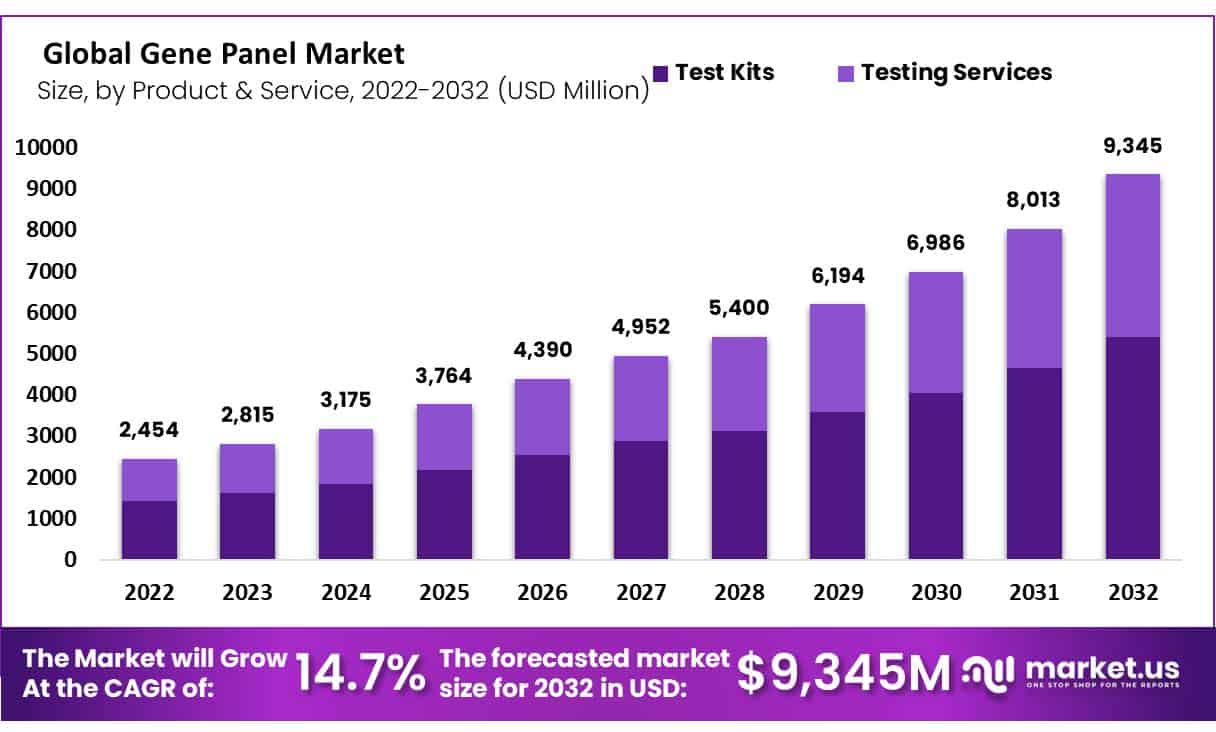
The Global Gene Panel Market size is expected to be worth around USD 2,454 Million by 2022 from USD 9,345 Million in 2032, growing at a CAGR of 14.7% during the forecast period from 2022 to 2032.
Discover some insights on market size before buying the full report – Request a sample report
Key Takeaway
- By Product & Service, the test kit segment generated a revenue share of 54% in 2022.
- By Technique, the amplicon-based approach segment has dominated the market, and it is growing at the highest CAGR over the forecast period 2023 to 2032.
- By Design, the predesigned gene panel segment held over 68% of the market for biopsy devices.
- By Application, the cancer risk assessment segment dominated the market.
- By End-User, the research & academic institutes segment held the highest revenue share of the market.
- In 2022, North America dominated the market with the highest revenue share of 45%.
- Europe will grow at a significant CAGR from 2023-2032.
Exploring the Impact of Generative AI on gene panel market
Generative AI is revolutionizing the gene panel market by enhancing data analysis, interpretation, and prediction capabilities. AI algorithms can analyze large volumes of genetic data, identify patterns, and provide valuable insights for genetic testing and personalized treatment decisions. Generative AI also aids in variant classification, interpretation of genetic variants, and the identification of potential disease-causing mutations.
Market Dynamics
Drivers:
- Increasing Prevalence of Genetic Disorders: The growing prevalence of genetic disorders and the need for accurate diagnosis drive the demand for gene panel testing.
- Advancements in Genetic Research: Ongoing advancements in genetic research, including the identification of disease-related genes, fuel the adoption of gene panels.
- Rise of Personalized Medicine: The shift towards personalized medicine, where treatment decisions are tailored to an individual’s genetic makeup, creates a demand for gene panel testing.
- Cost-Effectiveness and Efficiency: Gene panels offer cost-effective and efficient genetic testing compared to whole-genome sequencing, making it a preferred choice in many clinical settings.
Directly Purchase a copy of the report | Quick Delivery Available – https://market.us/purchase-report/?report_id=65536
Restraints:
- Limited Coverage: Gene panels focus on specific sets of genes, which means they may not capture all potential genetic variations, limiting comprehensive analysis.
- Variant Interpretation Challenges: Interpreting variants detected in gene panel testing can be complex, requiring expertise to determine their clinical significance and impact on disease risk.
- Ethical and Privacy Concerns: The genetic information obtained from gene panel testing raises ethical and privacy concerns, including issues related to data storage, confidentiality, and potential discrimination.
Opportunities:
- Expansion of Test Offerings: Gene panel manufacturers can explore opportunities to expand their test offerings, covering a broader range of diseases and conditions to meet evolving market demands.
- Integration of AI and Machine Learning: Leveraging generative AI and machine learning techniques can enhance the analysis and interpretation of gene panel test results, improving accuracy and efficiency.
- Adoption in Emerging Markets: The increasing awareness of genetic testing and advancements in healthcare infrastructure in emerging markets present opportunities for the growth of the gene panel market.
- Collaboration and Partnerships: Collaboration between gene panel manufacturers, research institutions, and healthcare providers can drive innovation, improve test accuracy, and expand market reach.
Challenges:
- Regulatory Frameworks: The gene panel market faces regulatory challenges related to test validation, quality control, and compliance with regional or national genetic testing guidelines.
- Data Interpretation Complexity: Interpreting genetic variations detected in gene panel testing requires continuous research, updated databases, and expert knowledge to provide accurate and actionable information.
Market Segments
Based on Product & Service
- Test Kits
- Testing Services
Based on Technique
- Amplicon Based Approach
- Hybridization Based Approach
Based on Design
- Predesigned Gene Panel
- Customized Gene Panel
Based on Application
- Cancer Risk Assessment
- Syndrome Specific
- High Penetrance
- High & Moderate Penetrance
- Comprehensive Cancer Risk
- Diagnosis of Congenital Diseases
- Pharmacogenetics
- Other Applications
Based on End-User
- Academic & Research Institutes
- Pharmaceutical & Biotechnology
- Hospital & Diagnostic Laboratories
Key Players
- Agilent Technologies, Inc.
- Thermo Fisher Scientific
- Bio-Rad Laboratories, Inc.
- Illumina, Inc.
- Qiagen
- Foundation Medicine, Inc.
- Guardant Health
- Myriad Genetic Laboratories, Inc.
- Cepheid
- Other Key Players
Take a Look at our Related Reports:
- EDiscovery Infrastructure Market
- AI Text Generator Market
- Generative AI in Gaming Market
- Artificial Intelligence in Genomics Market
- Generative Ai In Financial Services Market
- Generative AI In Retail Market
- Generative Ai In Logistics Market
- Generative AI In Sales Market
- Generative AI In Jobs Market
- Generative AI In Legal Market
- Generative AI In Sports Market
- Generative AI In Manufacturing Market
- Generative AI In Education Market
- Generative AI In Finance Market
- Generative AI In Insurance Market
- Generative AI In Medicine Market
- Generative AI In Supply Chain Market
- Generative AI In Travel Market
- Generative AI in Construction Market
- Generative AI in Edtech Market