The Workflow Management System market refers to the industry involved in the development, implementation, and utilization of software systems designed to streamline and automate business processes. These systems facilitate the efficient management of tasks, activities, and information within organizations, improving productivity, collaboration, and overall operational efficiency.
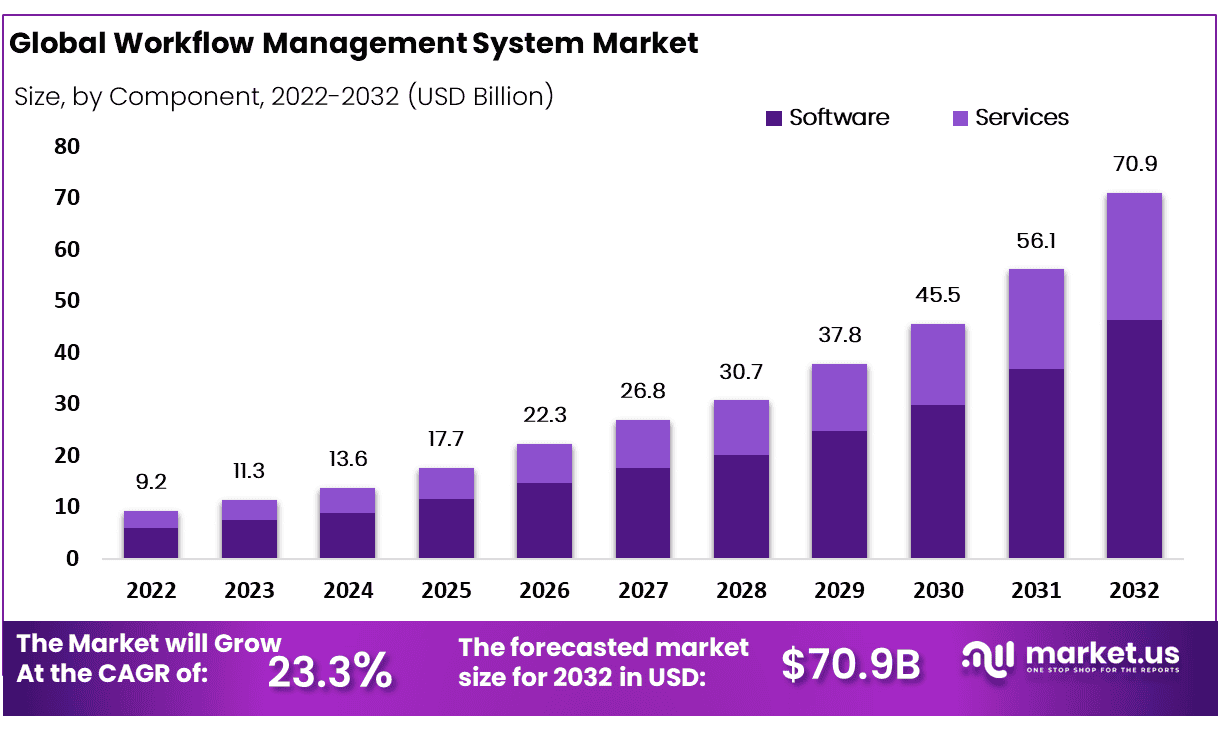
The Workflow Management System Market size is expected to be worth around USD 70.9 Billion by 2032 from USD 9.2 Billion in 2022, growing at a CAGR of 23.30% during the forecast period from 2023 to 2032. The market is being driven by the increasing demand for automation and efficiency in businesses of all sizes.
Discover some insights on market size before buying the full report – Request a sample report
Key Takeaways:
- The Workflow Management System market is driven by the increasing need for organizations to streamline their operations, improve process efficiency, and enhance productivity.
- Workflow Management Systems offer numerous benefits, including task automation, process standardization, improved communication and collaboration, real-time monitoring, and analytics for performance evaluation.
- The market is characterized by the presence of various vendors offering a range of workflow management software solutions, catering to different industries and organizational requirements.
Market Demand and Trend
The demand for WFM systems is growing rapidly, due to the increasing demand for automation and efficiency in businesses of all sizes. The market is expected to continue to grow in the coming years, as new and innovative WFM systems are developed.
Directly Purchase a copy of the report | Quick Delivery Available – https://market.us/purchase-report/?report_id=103331
The largest and Fastest growing market
The largest market for WFM systems is the Asia-Pacific region, followed by North America and Europe. The fastest growing market for WFM systems is the Middle East and Africa region, due to the growing adoption of technology in the region.
Role in Workflow Management System Industries
WFM systems play a number of important roles in businesses. They can be used to:
- Automate workflows
- Track progress
- Manage tasks
- Communicate with team members
- Report on performance
Positive Impacts of Generative AI on Workflow Management System Industries
Generative AI has the potential to have a number of positive impacts on the WFM market. These include:
- Improved efficiency: Generative AI can be used to automate tasks and improve the efficiency of workflows. This can lead to cost savings and increased productivity.
- Better decision-making: Generative AI can be used to analyze data and provide insights that can help businesses make better decisions. This can lead to improved performance and profitability.
- Personalized experiences: Generative AI can be used to personalize experiences for users. This can lead to increased customer satisfaction and loyalty.
Negative Impacts of Generative AI on the Workflow Management System Market
Generative AI also has the potential to have some negative impacts on the WFM market. These include:
- Job losses: Generative AI could lead to job losses in the WFM industry, as automated systems become more capable of performing tasks that were previously done by humans.
- Data security: Generative AI could be used to create synthetic data that could be used to attack WFM systems. This could lead to security breaches and data loss.
- Ethical concerns: There are ethical concerns about the use of generative AI in WFM systems. These concerns include the potential for discrimination and the misuse of personal data.
Market Dynamics
Drivers:
- Increasing need for streamlining and automating business processes to improve operational efficiency.
- Growing demand for standardized workflows and task automation.
- Advancements in technology, such as AI and cloud computing, enabling more robust and scalable Workflow Management Systems.
- Rising adoption of mobile workforce and remote work, necessitating accessible and flexible workflow solutions.
Restraints:
- Resistance to change and organizational culture barriers.
- Integration challenges with existing systems and legacy applications.
- Concerns about data security and privacy in cloud-based solutions.
- Cost considerations and budget constraints for implementing Workflow Management Systems.
Opportunities:
- Emerging markets with increasing digitization and adoption of technology.
- Integration of AI and machine learning capabilities for intelligent automation and predictive analytics.
- Growing demand for industry-specific Workflow Management Systems tailored to specific business needs.
- Collaboration opportunities with software vendors and service providers to offer comprehensive workflow solutions.
Challenges:
- Complexity in designing and implementing workflow processes for diverse business scenarios.
- Ensuring user adoption and change management within organizations.
- Maintaining data integrity and security in an increasingly interconnected environment.
- Keeping pace with evolving technology and market dynamics.
Target Audience to Benefit from this Report:
- Workflow Management System vendors and solution providers.
- IT and software companies involved in developing workflow automation solutions.
- Organizations across industries looking to streamline and automate their business processes.
- Business process consultants and advisors.
- Investors and venture capitalists are interested in the Workflow Management System market.
Market Segments:
By Component
- Software
- Services
By Deployment Mode
- Cloud
- On-Premise
By End-User
- IT & Telecom
- BFSI
- Retail
- Healthcare
- Other End-Users
Top Key Players in Workflow Management System Market
- International Business Machines Corporation
- Oracle Corporation
- Appian Corporation
- Bizagi
- Source Code Technology Holdings Inc.
- Pegasystems Inc.
- Newgen Software Technology
- Software AG
- Other Key Players
Future of Workflow Management System Market
The future of the WFM market is very promising. The advancement of generative AI is expected to have a significant impact on the future of the WFM market. Generative AI can be used to improve the efficiency and effectiveness of WFM systems, and to develop new applications for WFM systems. As a result, the WFM market is expected to grow rapidly in the coming years.
Conclusion
The WFM market is a rapidly growing market with a wide range of applications. Generative AI has the potential to have a significant impact on the future of the WFM market, by improving the efficiency, effectiveness, and personalization of WFM systems. As generative AI technology continues to develop, it is likely to lead to new and innovative applications for WFM systems.
Explore More Reports
- Physical Security Market Size Analysis (2023-2033)
- Corporate Wellness Market Supply and Demand 2023
- Carbon Black Market Trend Analysis Report by 2033
- Industrial Automation Market Global Report [PDF – 2023]
- Image Sensors Market Growth Rate By 2033
- AI Voice Generator Market Trends and Forecast by 2023-2033
- Proteomics Market Analysis and Growth in 2023
- AI Video Generator Market Size Analysis (2023-2033)
- Probiotic Market Supply and Demand 2023
- Semiconductor IP Market Trend Analysis Report by 2033
- Ready Meals Market Global Report [PDF – 2023]
- Cloud Computing Market Growth Rate By 2033
- Sportswear Market Trends and Forecast by 2023-2033