Introduction:
The smart wearable market has experienced significant growth in recent years, driven by advancements in technology and the increasing demand for wearable devices. These devices, equipped with sensors, connectivity features, and computing capabilities, have become increasingly popular among consumers. From smartwatches and fitness trackers to smart glasses and smart clothing, smart wearables have expanded their presence across various industries and applications.
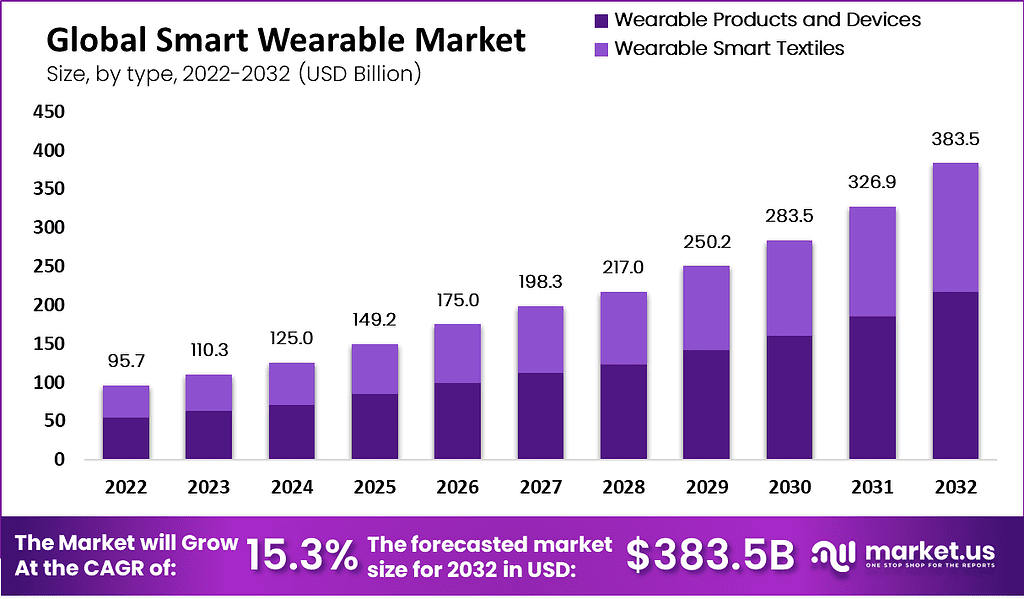
The Global Smart Wearable Market size is expected to be worth around USD 383.5 Billion by 2032 from USD 95.7 Billion in 2023, growing at a CAGR of 15.3% during the forecast period from 2022 to 2032.
Get additional highlights on major revenue-generating segments, Request a smart wearable market sample report at https://market.us/report/smart-wearables-market/request-sample/
Editor’s Choice:
One standout device in the smart wearable market is the Apple Watch. Known for its sleek design, comprehensive health tracking features, and seamless integration with other Apple devices, the Apple Watch has become a leader in the smartwatch segment. With a wide range of functionalities, including heart rate monitoring, fitness tracking, messaging, and app support, the Apple Watch offers a compelling user experience.
Key Takeaway:
- Based on type, in 2022, the smart wearable market was dominated by the wearable products and devices segment owing to their convenience and functionality.
- By product, in 2022, the wristwear segment dominated the largest market share at 38% in the product segment.
- Based on application, the consumer electronic segment holds a significant share of the application segment in 2022.
- In 2022, North America dominated the market with the highest revenue share of 37.8%.
- APAC is expected to have the highest CAGR among all regions, owing to growing awareness about health and fitness, and a large population.
Want more marketing insights? Visit Here – https://market.us/report/smart-wearables-market/
What is Smart Wearable?
Smart wearables refer to electronic devices that can be worn on the body, typically worn as accessories or clothing. These devices are designed to enhance and augment the user’s daily activities by providing various functionalities and connectivity options. Smart wearables incorporate sensors, processors, wireless communication technologies, and often have companion mobile applications or cloud-based platforms for data analysis and interaction.
Benefits:
- Health and Fitness Tracking: Smart wearables enable users to monitor their health and fitness levels by tracking metrics such as heart rate, sleep patterns, step count, calories burned, and more. This data helps users gain insights into their well-being and make informed decisions about their lifestyle.
- Connectivity and Notifications: Smart wearables can seamlessly connect with smartphones and other devices, allowing users to receive notifications, calls, and messages directly on their wrists or through audio prompts. This reduces the need to constantly check smartphones and provides convenient access to information on the go.
- Personalized Assistance: Many smart wearables incorporate virtual assistants or voice-controlled interfaces, enabling users to interact with their devices using natural language commands. This facilitates tasks such as setting reminders, sending messages, making calls, and accessing information without the need for manual input.
- Convenience and Style: Smart wearables come in various forms, including smartwatches, fitness trackers, smart glasses, and smart clothing, offering users a range of options to suit their preferences and needs. These devices often blend fashion with technology, allowing users to express their style while enjoying the benefits of wearable technology.
Key Market Segments:
Based on Type
- Wearable Smart Textiles
- Wearable Products and Devices
Based on Product
- Bodywear
- Neckwear
- Headwear
- Wristwear
- Footwear
- Eyewear
Based on Application
- Defense
- Healthcare
- Enterprise & Industrial Application
- Fitness & Wellness
- Consumer Electronics
- Other Applications
Conclusion:
The smart wearable market has witnessed remarkable growth, fueled by advancements in technology and the desire for more connected and personalized experiences. Smart wearables provide users with health and fitness tracking, connectivity, personalized assistance, and convenience. As technology continues to evolve, we can expect further innovation in this field, leading to even more sophisticated and functional smart wearable devices.
FAQs:
1. Are smart wearables only for fitness purposes?
Smart wearables are not limited to fitness purposes. While fitness trackers are popular, smart wearables encompass a wide range of devices with various applications. They can include smartwatches, smart glasses, smart clothing, and more, each offering different functionalities beyond fitness tracking.
2. Do smart wearables require a smartphone to function?
Many smart wearables rely on a smartphone for full functionality. They often connect to smartphones via Bluetooth or Wi-Fi to synchronize data, receive notifications, and access additional features. However, some standalone smartwatches can operate independently with their own SIM cards, enabling cellular connectivity without the need for a smartphone.
3. Are smart wearables secure?
Smart wearables, like any connected device, can have security considerations. Manufacturers employ encryption, authentication, and other security measures to protect user data. Users should also take precautions such as using strong passwords, keeping devices updated with the latest firmware, and being cautious of sharing sensitive information.
5. Can smart wearables be customized?
Many smart wearables offer customization options to personalize the user experience. Users can often choose from various watch faces, display settings, and notification preferences. Additionally, some smart wearables allow users to install additional apps or customize settings according to their preferences.
What is the future of smart wearables?
The future of smart wearables holds exciting possibilities. As technology advances, we can expect improvements in sensor accuracy, battery life, processing power, and connectivity. Smart wearables may become more seamlessly integrated into our daily lives, offering even more sophisticated features and becoming essential tools for health monitoring, productivity, and entertainment.
Explore More Reports
- Fractional Horsepower Motors Market Innovations and Future Outlook 2023 to 2033
- Coin-Operated Vending Machines Market Real Time Analysis and Forecast up to 2033
- Military Wearables Market Developments And Future Scope To 2033
- Remote Towers Market Strategies, High Growth Rate By 2033
- Robotics and Automation Actuators Market Insights Focusing on Primary Trends until 2033
- Unmanned Composites Market Demand and Developments by 2033
- 5G in Defense Market 2023: Huge B2B Opportunities 2033
- Battery Sensor Market Expected a Major Surge in Revenue by 2033
- Exhaust System Market Predicted to Reach Maximum Revenue by 2033
- EV Charging Cables Market Global Statistics and Forecast to 2033
- Riflescopes Market Present Scenario on Revenue Predictions by 2033
- Marine Interiors Market Sales Funnel and SWOT Analysis 2023-2033
- 5G Market Rising Trends And Revenue Analysis 2033
- Commercial Vehicle & Off-Highway Radar Market 2023 Sales Strategy and Value Chain by 2033