The chatbot market has experienced significant growth in recent years, driven by the need for improved customer experiences and advancements in AI and natural language processing technologies. Chatbots are being deployed across various industries to provide 24/7 customer support, personalized interactions, and streamlined processes. They are integrated with messaging platforms and offer analytics capabilities for data-driven decision-making.
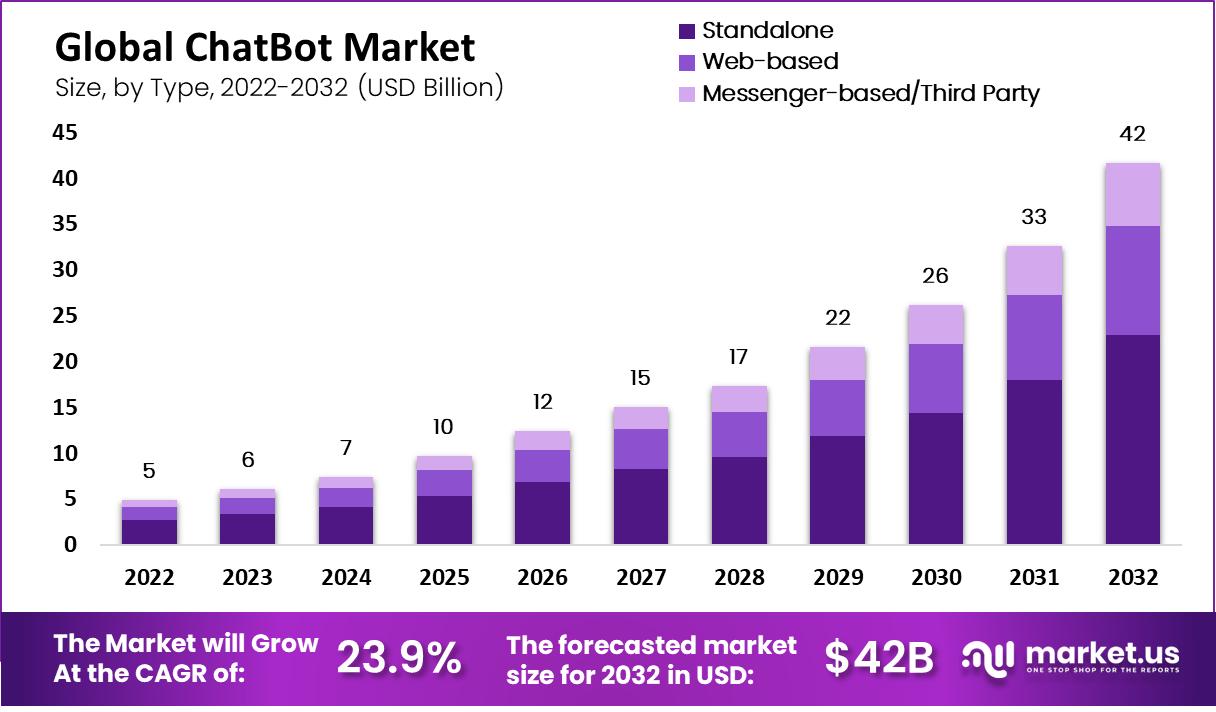
In 2022, the Global Chatbot Market size was valued at USD 4.92 billion. Between 2023 and 2032, this market is estimated to register the highest CAGR of 23.91%. It is expected to reach USD 42 billion in the forecast period.
Directly Purchase a copy of the report | Quick Delivery Available –https://market.us/purchase-report/?report_id=60914
The market demand for chatbots is fueled by the need for personalized customer experiences, improved efficiency, and cost savings. Businesses are investing in chatbot technology to automate repetitive tasks and enhance customer engagement. The trend of integrating chatbots with messaging platforms and voice-enabled capabilities is expected to continue, as well as the development of more advanced conversational AI.
Discover market potential and regional growth opportunities. Download PDF Sample Report
Key Takeaways:
- Chatbots enhance customer experiences, providing instant and personalized interactions.
- AI and NLP technologies have improved chatbot capabilities, enabling context-aware responses.
- Industry-specific chatbots are being deployed in e-commerce, healthcare, banking, and more.
- Integration with messaging platforms offers a seamless user experience.
- Chatbot analytics provide valuable insights for optimization and understanding customer behavior.
Here are some key aspects of the chatbot market:
- Increasing Demand for Improved Customer Experience: Companies across industries are recognizing the value of chatbots in enhancing customer experience. Chatbots provide 24/7 customer support, instant responses, and personalized interactions, leading to higher customer satisfaction and retention. They can handle routine inquiries, process transactions, and even offer product recommendations, thereby freeing up human agents to focus on more complex tasks.
- Rise of AI and NLP Technologies: The advancements in AI and NLP technologies have significantly improved the capabilities of chatbots. Machine learning algorithms enable chatbots to learn from interactions and provide more accurate and context-aware responses. Natural language processing enables chatbots to understand and interpret user queries, even with variations in language, slang, or intent. These technologies continue to evolve, enabling chatbots to offer more sophisticated and human-like interactions.
- Industry-Specific Applications: Chatbots are being deployed across a wide range of industries, including e-commerce, healthcare, banking, travel, and more. In e-commerce, chatbots assist customers with product recommendations and support during the purchasing process. In healthcare, they can help with appointment scheduling, symptom assessment, and basic medical advice. Banking chatbots handle account inquiries, transactional requests, and even provide financial advice. Industry-specific chatbots are customized to meet the unique needs and requirements of each sector.
- Integration with Messaging Platforms: Chatbots are commonly integrated with popular messaging platforms such as Facebook Messenger, WhatsApp, and Slack, enabling businesses to reach customers through channels they already use regularly. This integration provides a seamless experience for users, who can interact with chatbots within their preferred messaging apps, eliminating the need for separate applications or websites.
- Chatbot Analytics and Insights: Analytics capabilities are becoming an integral part of chatbot platforms, allowing businesses to gather valuable data on user interactions, preferences, and trends. This data can be used to optimize chatbot performance, identify areas for improvement, and gain insights into customer behavior and needs. Chatbot analytics enable businesses to make data-driven decisions and refine their chatbot strategies for better outcomes.
- Voice-Enabled Chatbots and Conversational AI: The emergence of voice-enabled chatbots, powered by voice recognition and natural language understanding technologies, is another notable trend. Voice assistants like Amazon Alexa and Google Assistant have popularized voice interactions, and businesses are incorporating voice capabilities into their chatbots to offer a more intuitive and hands-free user experience. Conversational AI, which focuses on creating more dynamic and interactive conversations with chatbots, is also gaining traction, allowing for more engaging and human-like interactions.
To get an idea of the overall scope of the full report, Download Sample PDF Report Here: https://market.us/report/chatbot-market/request-sample/
Play a Larger Role in customer service, marketing, and sales. They will become more sophisticated, capable of handling complex queries and transactions. As voice-enabled chatbots and conversational AI continue to evolve, they will offer more intuitive and human-like interactions. Chatbots will also be integrated into smart devices and virtual assistants, further expanding their reach and functionality.
Regional Landscape:
The chatbot market has a global presence, with North America leading in terms of adoption and technological advancements. Europe and Asia Pacific are also prominent regions due to increasing digitization and growing investments in AI. Developing countries in Latin America, the Middle East, and Africa are witnessing increasing demand, driven by expanding digital infrastructure and rising smartphone penetration.
5 Predictions about the Future:
- Chatbots will become even more conversational and human-like, blurring the line between human and machine interactions.
- Voice-enabled chatbots will become more prevalent, as voice recognition technology improves.
- Chatbots will play a key role in personalized marketing campaigns, offering targeted recommendations and promotions.
- Chatbots will be integrated into smart homes and IoT devices, providing seamless and intelligent interactions.
- Chatbots will continue to evolve with advancements in AI and NLP technologies, delivering more accurate and context-aware responses.
Increasing Demand in Developing Countries:
Developing countries are experiencing increasing demand for chatbots due to expanding digital infrastructure, rising internet penetration, and smartphone adoption. As businesses in these regions seek to enhance customer experiences and streamline operations, chatbots offer cost-effective solutions and enable them to compete on a global scale.
Market Dynamics
Drivers:
- Need for personalized customer experiences.
- Automation of repetitive tasks and cost savings.
- Advancements in AI and NLP technologies.
- Integration with messaging platforms and voice-enabled capabilities.
- Industry-specific applications and benefits.
Restraints:
- Data privacy and security concerns.
- Challenges in understanding and responding to complex queries.
- Limited awareness and understanding of chatbot capabilities.
- Resistance to change and reliance on traditional customer service channels.
- Integration challenges with legacy systems and processes.
Opportunities:
- Industry-specific chatbot solutions for niche markets.
- Integration with emerging technologies (AR, IoT, etc.).
- Expansion into sectors like education, hospitality, and government services.
- Multilingual chatbot capabilities.
- Solutions tailored for SMEs.
Challenges:
- Ensuring data privacy and security.
- Developing advanced NLP capabilities for complex queries.
- Educating businesses and consumers about chatbot benefits.
- Overcoming resistance to change in customer service practices.
- Integrating with legacy systems and processes.
Key Market Segments
Based on Type:
- Standalone
- Web-based
- Messenger-based/Third party
Based on Application:
- Healthcare, Retail
- Banking
- Financial Services
- Insurance (BFSI)
- Media and entertainment
- Travel & Tourism
- E-commerce
Top Key Players in The Market:
Listed below are some of the most prominent bio-based surface disinfectant industry players.
- Acuvate
- Aivo
- Artificial Solutions
- Botsify Inc.
- Creative Virtual Ltd.
- eGain Corporation
- IBM Corporation
- Inbenta Technologies Inc.
- Next IT Corp.
- Nuance Communications, Inc.
- Other Key Players
In summary, the chatbot market is experiencing substantial growth, driven by the demand for improved customer experiences, advancements in AI and NLP technologies, and industry-specific applications. The integration of chatbots with messaging platforms, the availability of analytics insights, and the rise of voice-enabled chatbots and conversational AI are shaping the future of this market. As businesses continue to prioritize customer engagement and automation, chatbots are expected to play an increasingly important role in their digital strategies.
Explore More Studies Published by Market.us Research:
- Artificial Intelligence Market to Reach US$ 2745 Bn by 2032, North America is Expected to Dominate the Worldwide Market
- Kidney Stone Management Market Size ($3,595 Mn by 2032 at 4.6% CAGR) Global Analysis by Market.us
- Acute Bacterial Skin & Skin Structure Infections Treatment Market Predicted to Garner USD 23.3 Billion By 2032, At CAGR 9.6%
- Caustic Soda Market Predicted to Garner USD 73.4 Billion By 2032, At CAGR 5.2%
- Energy Management System Market to Experience Robust Growth at a CAGR of 14.6% during 2022-2032 | Market.us Report
- Azelaic Acid Market Revenue to Hit USD 422.21 Bn by 2032; North America dominates with 38.7% of the Market Share
- Hyaluronic Acid Market Projected to Grow at 7.7% CAGR, Crossing US$ 13.9 Billion by 2032, Reports Market.us Research
- Fuel Cell Electric Vehicles Market Poised for Substantial Growth, Foretasted to Surpass US$ 199.4 Billion by 2032
- Vision Care Market to Reach Valuation of USD 113.8 Bn at CAGR of 5% by 2032
- Hops Market Expected to Experience Robust Growth with a Projected CAGR of 4.20% during the Forecast Period
- Telehealth Market to Reach Valuation of USD 36.5 Bn at CAGR of 17.3% by 2032
- Next-Generation Sequencing Market to Witness Strong Growth, with a Projected CAGR of 14.6% | Market.us Report